
By Sunahwar Ali:
Former Chief Whip, Tower Hamlets Council, Anti-Racist, Anti-Injustice & Anti-Corruption Campaigner
London – Dhaka
There are moments when a single act of courage cuts through the fog of war.
This week, Spain delivered that moment.
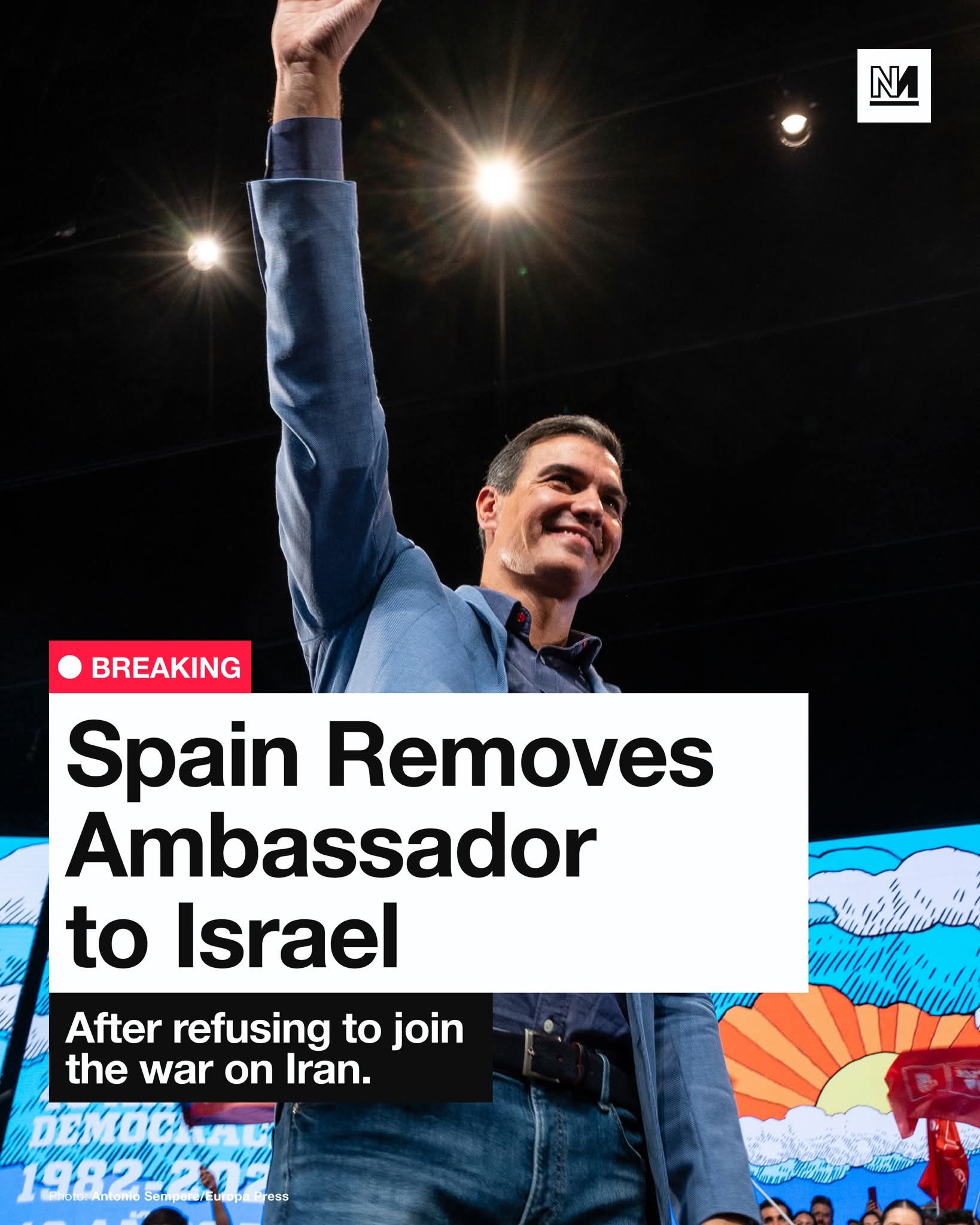
The Spanish government has permanently withdrawn its ambassador from Israel, downgrading diplomatic representation in Tel Aviv to chargé d’affaires level.
This is not a temporary recall—it is a decisive break, formalised in Spain’s official gazette (BOE) on March 11, 2026, and signed by King Felipe VI, terminating the appointment effective March 10.
Why now? Because Spain refused to be complicit in war.
When the US and Israel launched military strikes against Iran, Prime Minister Pedro Sánchez’s government did what too few nations dare:
it said no. Spain explicitly denied Washington permission to use the Rota and Morón military bases for operations supporting the attacks on Iran. At least 11–15 US tanker aircraft (KC-135s) had to depart Spanish bases as a direct result, relocating to other locations such as Germany and France.
Let us be clear. Spain is a NATO member.
It is a longstanding US ally. Yet when asked to facilitate military action it considered unlawful, it stood on principle rather than submission. Sánchez called the strikes “unjustified and dangerous,” violating international law. His Foreign Minister was precise:
“Spanish bases will not be used for anything outside the UN Charter.”
The UN’s Dangerous Double Standard
This act of Spanish courage stands in stark contrast to what happened at the United Nations on March 11–12, 2026, when the Security Council adopted Resolution 2817 condemning Iran’s attacks in the Gulf, co-sponsored by an unprecedented 135 nations.
On the surface, that vote appeared to be a strong, unified stance by the international community.
But I look at that vote and see not a victory for peace, but a glaring example of the very inequalities that plague our global system—the same inequalities Spain has now bravely rejected.
Where was this overwhelming consensus when the bombs began to fall on February 28? Where were the 135 co-sponsors ready to condemn the initial strikes that ignited this inferno?
The resolution before the Council conveniently ignored the root causes of the current crisis, as Iran’s Ambassador rightly pointed out. It chastised the retaliation but remained silent on the provocation.
This is not justice; it is a selective application of international law, where the grievances of some nations are validated while others are dismissed.
The Human Cost Conveniently Ignored
Let us speak plainly about the human cost that the UN resolution glosses over.
We hear condemnation of attacks on infrastructure. But what of the blood of civilians killed since the end of February?
My heart, and I am sure the hearts of all justice-loving people, breaks for the 165 schoolgirls in Minab, whose lives were snatched away in what has been described as a “massacre” at Shajareh Tayyebeh girls’ elementary school on February 28. Their voices are not heard in the chamber of the Security Council. Their blood does not appear in the text of that “balanced” resolution.
And let us not forget the wider catastrophe. Since October 2023, over 72,000 Palestinians have been killed in Gaza, with over 171,000 injured. Ninety percent of the Strip’s infrastructure lies in ruins.
Now war has expanded to Iran.
An anti-racist and anti-injustice perspective demands that we value every life equally, whether the victim is in Tel Aviv, Minab, or Gaza City.
When we pick and choose which civilian deaths to mourn and which to weaponize, we betray the very principle of universal human dignity.
The Abstentions That Spoke Volumes
The abstention of China and Russia on the UN resolution was telling. While they did not use their veto, their reluctance to endorse the text signalled a recognition that it was, as Russia’s ambassador stated, “extremely unbalanced.”
It was a document born of geopolitical maneuvering, not a genuine effort to halt the cycle of violence.
The simultaneous failure of Russia’s broader ceasefire call further exposed the Council’s paralysis.
It is a body so divided by power politics and “bloc solidarity” that it cannot even agree to urge all sides to stop fighting.
Four votes in favour of peace for everyone. Thirteen votes in favour of condemning one side.
That is not diplomacy.
That is warfare by other means.
Spain’s Courageous Alternative
Against this backdrop of international failure, Spain’s actions shine all the brighter.
For this act of sovereignty, Spain now faces threats.
Donald Trump has threatened to “cut off all trade,” calling Spain a “bad ally.” Senator Lindsey Graham accuses Spain of emboldening Iran.
But the truth is this:
Spain is refusing to be a launchpad for destruction while the human cost mounts.
Across Europe, Sánchez has been a lonely voice opposing the Iran war. Spain has imposed a total arms embargo on Israel, recognised Palestinian statehood, and now dramatically downgraded diplomatic ties. Last October, parliament formally banned weapons sales to Israel. Spanish ports and airspace are closed to arms shipments.
The Israeli response has been predictably hostile.
Foreign Minister Gideon Sa’ar accused Spain of antisemitism—a tiresome tactic. Criticising a government’s actions is not hostility to a people.
It is hostility to injustice.
What makes Spain’s position powerful is its resonance with the Spanish people. When Sánchez revived the slogan “No to war”—the same cry against the Iraq War in 2003—he tapped deep national memory.
Mass demonstrations fill Madrid’s streets demanding complete severance from what protesters call “the occupation.”
This is democracy in action.
Critics call this symbolic.
They are wrong. Symbols matter in diplomacy because they signal resolve. When Israel withdrew its ambassador from Madrid in May 2024 over Palestine recognition, it was making a statement.
Now Spain has answered.
Both countries now have chargé d’affaires—a mutual demotion that speaks volumes.
The threats from Washington are real but hollow. Trade involves mutual benefit. Spain’s response has been dignified.
A View from the Global Majority
From my vantage point, working between London and Dhaka, I see a world weary of double standards.
The global majority—the millions of people across Asia, Africa, and the Global South—see clearly that the rules are applied differently depending on who is striking and who is being struck.
We campaign against corruption in local councils, but what is this if not a corruption of the very principles of international justice? When powerful nations can orchestrate a global consensus against their adversary while escaping scrutiny for their own actions, the entire system loses legitimacy.
Spain is showing that governments can choose international law over intimidation. They can choose humanity over allegiance.
This is not anti-American or anti-Israeli.
It is pro-justice. The principles we apply to our own societies—rule of law, protection of civilians—must apply internationally, or they mean nothing.
The Path Not Taken
The UN resolution did not pave a path to peace.
It deepened the trenches of conflict.
It told the people of Iran and the region that their suffering is conditional, that their security is secondary.
It told the world that if you are on the wrong side of powerful nations, your dead will be forgotten, your injuries ignored, and your aggression—even in self-defence—will be condemned.
Spain offers a different path.
True leadership, true justice, would demand a cessation of all hostilities.
It would demand an independent investigation into all crimes committed by all parties. It would require a conversation that addresses the legitimate security concerns of every nation and people in the region, not just those with the power to convene the Security Council.
Spain’s embassy in Israel remains open. The door is not slammed shut.
But the message is unmistakable: normal business cannot continue while war crimes are committed. Business as usual is not an option when children die.
A Call to Follow
The question is whether other nations will follow Spain’s lead. Will Europe continue muttering disapprovingly while facilitating war?
Or will Spain remain a single point of light?
I hope Madrid’s courage spreads. I hope leaders remember their first duty is to humanity.
For now, I salute Spain.
I salute Sánchez for standing firm. I salute the Spanish people for filling the streets.
And I salute a government that remembered: saying no to war is not weakness—it is the highest form of strength.
Until more nations find that courage, resolutions like the one passed on March 11–12 will remain not steps toward peace, but weapons in an ongoing war.
Sunahwar Ali is a former Chief Whip of Tower Hamlets Council and a long-time campaigner against racism, injustice, and corruption, working between London and Dhaka.


Downloaded sx66app the other day, not gonna lie, it’s pretty decent. Check it out for yourself. sx66app
Alright, okttslot is worth checking out in opinion. Check it out and see. okttslot
Got jl7betapp on my phone, it’s pretty fun to browse here jl7betapp